Apollo’s grief and anxiety
The FriendApollo’s grief and anxiety shape his passage from the home of his dead owner, Deceased Friend, into the care of Narrator. His repeated waiting, strange howling, withdrawal, and later fits of shaking make mourning visible as bodily behavior rather than an emotion he can explain. The people around him try to interpret and relieve that suffering, but the narrative refuses the comfort of certainty: Apollo may be grieving, yet neither his history nor his thoughts can be fully known.
Loss and Displacement
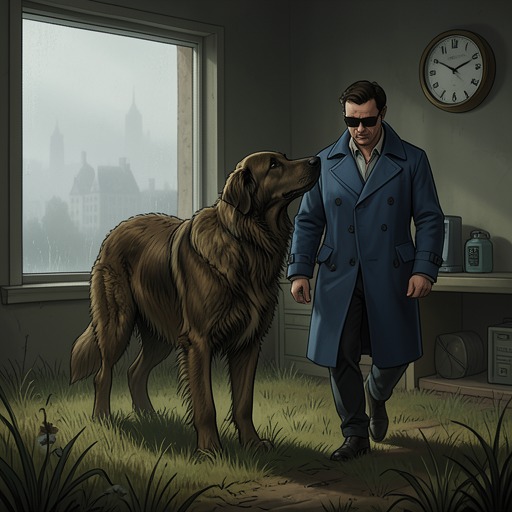
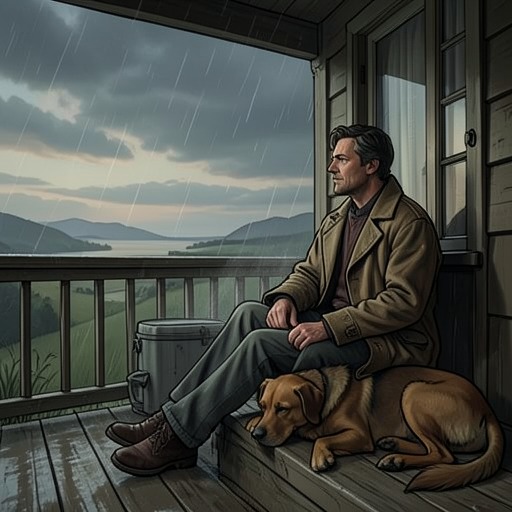
After Deceased Friend dies, Apollo waits by the door, apparently expecting him to return. For a time he refuses food, and his intermittent howling or wailing becomes unbearable to the woman caring for him. She tries to distract him with treats, but he turns away; once, he growls at her. The sound wakes her at night and leaves her listening until she fears she will go mad. Seeing Apollo return to the door or begin keening again repeatedly undoes her composure. She eventually puts him in a kennel because she does not know what else to do, though the cost is high and she fears having to give him away or take him to the pound. She also believes it would be cruel to bring him back: after being gone from the house, he might never be happy there again.
The story of Hachikō, who continued to meet the train at Shibuya Station for nearly ten years after his master died, offers a public legend of canine fidelity, but no explanation for Apollo. When Narrator takes him in, she finds a dog who mostly ignores her, makes eye contact only briefly, and has eyes that remind her of Deceased Friend. His still expression calls to mind Greyfriars Bobby lying on his master’s grave; she has not yet seen Apollo wag his tail. These comparisons make his attachment legible to human observers while also marking the distance between a familiar story about loyal dogs and the particular animal in front of them.
Withdrawal and Signs of Distress
Apollo walks with his head lowered and, once home, throws himself onto the bed. Narrator reads this as the exhaustion of mourning and becomes convinced that he understands Deceased Friend is gone for good and that he will never return to the brownstone. At other times Apollo lies stretched out facing the wall. After a week, caring for him feels more like being his jailer than his caretaker. His apparent knowledge of the loss does not bring relief; it makes the separation seem permanent to Narrator, while his silence leaves her unable to verify what he understands.
The howling returns after Narrator has taken Apollo in. A neighbor who lives above her says that he missed Deceased Friend; Narrator understands the remark to mean that Apollo is howling again. Later, the symptoms change in form. At the veterinarian’s office, she describes episodes in which Apollo looks around as if confused, clamps his tail between his legs, crouches close to the floor, and then shakes uncontrollably. The fits last from a few minutes to as long as half an hour. Narrator says he seems to think something terrible is about to happen, while admitting privately that watching the attacks sometimes brings her to tears.
Care, Treatment, and Uncertainty
The veterinarian believes Apollo is mourning his previous owner and that repeated changes in his surroundings have intensified his distress. He explains that medication for canine anxiety and depression may take weeks to work and may not work at all, so he recommends leaving it as a last resort. Instead, he advises Narrator not to leave Apollo alone for too long, to talk to him, and to exercise him as much as possible; massage is another possibility if Apollo will tolerate it. The advice offers practical care, not a promise of recovery. The veterinarian warns that Apollo may never recover, whatever Narrator does, and that she may never know why.
That uncertainty is not simply a problem of missing information about Apollo’s past. The veterinarian challenges the assumption that dogs are simple or transparent to human understanding: they are more mysterious and complicated than people tend to believe, and without a shared language their inner lives cannot be known fully. Apollo’s distress therefore resists a complete diagnosis, even when its signs are unmistakable. His fear can be observed and answered, but its exact cause and meaning remain beyond Narrator’s reach.
A Changing Bond
Narrator tries to make Apollo’s new home less frightening by staying with him whenever she is not at school. When apart, she remains anxious to return. He greets her at the door, though his look seems to her to register how hard the waiting has been; she even wonders whether he has been waiting there the whole time, and whether he is still waiting for Deceased Friend. His tail begins to move from side to side, a definite but wistful wag rather than the exuberant motion associated with a Great Dane. The change suggests an attachment developing between Apollo and Narrator without proving that his earlier grief has passed.
Massage becomes part of their routine. Narrator alternates Apollo from one side to the other and pauses to rub his chest, which he appears to prefer; he dislikes having his paws touched, although she keeps trying. The daily care answers the veterinarian’s advice while making closeness a matter of patience and negotiation. Apollo has grown used to his new home and to Narrator, yet she continues to worry about leaving him alone and about what the waiting might mean to him. His recovery is therefore neither a clean resolution nor a simple replacement of one attachment with another. Apollo’s grief remains inseparable from the limits of human interpretation: Narrator can stay beside him, respond to what he does, and love him, but she cannot know exactly what he remembers or whether he has stopped waiting.